Your knees are marvelous mechanical constructions–complicated joints that support your weight, smoothen out a shock, and set you in motion. However, once injured, arthritis or other general wear and tears attack, then such basic and common things as walking becomes a task. Here comes the unsung savior of the joints: the knee brace. Yet when there are so many choices available in the market how do you pick?
This is not a mere list, it is your final roadmap to the Knee Braces knowledge that will enable you to make an informed and confident choice as far as your mobility and pain reliever are concerned. And now it is time to immerse ourselves in the realm of support and get the ideal match.
Understanding Knee Braces
Knee braces are aids to support the function of a joint, relieve pain, prevent trauma, and recover by means of compression, alignment, and a controlled movement in the daily activity or sports usage in a safe manner.
What Knee Braces Are and How They Work
Knee braces can be considered as kind of external aids to your joint. They are not magic, and they are complex devices, which are meant to achieve stability, lessen pain, manage movement, and encourage healing. Fundamentally, they work by:
- Compression: Knee braces enhance blood delivery, assist in minimization of swelling and offer proprioceptive feedback that makes the body more aware of joint position, and improves the general control of movement.
- Stabilization: Knee braces help injured structures by restricting side-to-side and twisting movements that might exacerbate strain or worsen symptoms during movement.
- Offloading: Redistributing pressure through offloading helps relieve some pressure off injured cartilage or arthritis-affected portions, relieving pain while improving comfort during weight-bearing activities such as walking.
- Immobilization: Post-operative knee braces offer immobility after knee surgery or trauma in order to promote healing while decreasing risks.
Common Reasons People Use Knee Braces
The motives why people wear them are as diverse as the ones who wear them:
- Post-Surgical Recovery: ACL reconstruction, meniscus repair or other surgery Knee braces assist the recovery process following surgery by reducing the amount of harmful movement and encouraging a safe, controlled recovery process.
- Ligament Injuries: Braces are additional support to ACL, MCL, PCL or LCL sprains and tears and can help support damaged ligaments on a day to day basis and in physical therapy.
- Knee brace: Knee braces are special orthoses that ease the pain of osteoarthritis through decreasing the stress on the joints, improving the position of the joints, and relieving the pain when standing or walking.
- Patellofemoral Pain: Braces help in correcting the problem of tracking the knees in the runners and the kneecap by aligning the patella with better alignment and the decreased pressure during movement.
- Prevention: Knee braces are worn by the players of contact or high-impact sports to minimize injury risk particularly after they have suffered knee injuries.
- General Instability: Knee braces offer additional support and confidence-increasing mobility to joints that become weak or give way during movement due to weak or injured muscles, ligament damage or previous trauma, increasing overall movement ability and confidence overall.
Overview of Different Types of Knee Braces
The knee brace category is functional. Starting with lightweight sleeves up to heavyweight exoskeletons, there is a certain type of mission in each case. To start with, to realize these categories is the initial step towards your own “aha! moment.
Types of Knee Braces Explained
Types of knee braces include prophylaxis, functional, rehabilitative and unloader that provide varying degrees of support, flexibility and protection based on the risk of injury, severity of the condition and the physical activity to which the knee is subjected.
Functional Knee Braces (ACL injuries, post-surgery)
These are the prosthetic knee cushions of the unstable knees that are mostly custom-crafted or over-the-counter to address a specific ligament deficiency. Their construction incorporates both the rigid frames and the use of two hinges in order to eliminate the abnormal movements that cause injuries but allow a safe range of motions. They are the ones to resort to in athletes who have undergone an ACL reconstruction and those with permanent ligament instability.
Prophylactic Knee Braces (sports injury prevention)
These braces are popular with the football linemen and they are constructed to avert knee injuries in high-contact sports. They include hard side bars and are used to shield the medial collateral ligament (MCL) against the lateral blows. They are controversial with regard to their effectiveness in any athlete, however, they are standard in collision sports.
Rehabilitative Knee Braces (post-injury recovery)
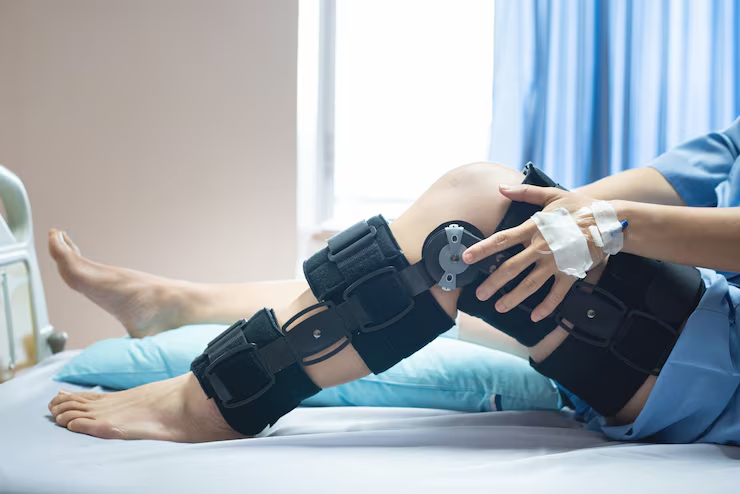
These braces are all about control and they are used mostly following surgery or after a major acute injury. They are made to stabilize the knee or simply act as a very restrictive factor towards the range of movement to cover healing structures. The doctor or surgeon will determine the maximum movement of the hinge, and as time goes on, it can be expanded.
Unloader Knee Braces (arthritis and joint pain relief)
An innovation to osteoarthritis patients. The design of these braces incorporates an advanced shoe of pads and straps to actually de-load or offload weight off the injured, painful compartment of the knee (typically, the inner one). They are also able to alleviate the strain on the arthritic region by several manners, therefore reducing pain and enhancing functionality, which can even slow down the surgical requirement.
Hinged Knee Brace (stability for weak or injured knees)
It is a flexible type of bridge that supports mobility. It is usually characterized by soft sleeves that have hard metallic or plastic hinges along the side. The design eliminates pernicious cross-way motion (such as buckling) whilst allowing benign forward and back movement. Hinged Knee Brace is suitable in the case of moderate ligament tear, arthritis, or stability after injury. To further enhance the dynamic one, a Dynamic Knee Brace can have flexible hinges or spring assisted design so that it adapts to your motion to provide responsive support during your activity.
Compression Knee Sleeves (lightweight support for active users)
The most popular and least complicated one. They are made of stretchy neoprene or nylon mixes, which offers mild compression, warmth, and proprioception. They are good to treat small aches, swelling, patellar tracking or to offer light support to the activity such as running or lifting weights. They fail to provide ligament injuries with structural stability.
How to Choose the Right Knee Brace
Before selecting an effective knee brace, several key criteria need to be taken into account, including injury type and support requirements; comfort level; level of activities performed and medical guidance to ensure maximum stabilization, mobility and long-term efficacy without undue risks.
Key Factors to Consider (fit, material, comfort)
The selection of the suitable brace depends on science and individual comfort.
- Fit: Paramount. A brace that does not fit well is useless and may also be detrimental. It must not be tight to cut off circulation.
- Material: Neoprene is warm and compressive and is capable of retaining heat. Moisture-wicking fabrics are breathable and can be used well during sport or in hot weather.
- Comfort and Design: Take into account the closure (straps vs. slip-on), weight and profile under clothes. Will you wear it on a daily basis or on a running basis only?
How to Measure Your Knee Correctly
Take a flexible measure!
- Circumference: Measuring the circumference around the midpoint of your kneecap is the measurement of most braces.
- above and below: Measure too 6 inches above the point of your knee and 6 inches below. Compare them with the size chart of the manufacturer–they are frequently more so than the knee itself.
Best Knee Braces for Specific Conditions
- ACL Injury / Post-Op: A hinged knee brace that is both functional and/or prescription with adjustable range-of-motion can be used to stabilize the knee, provide protection to healing ligaments, and assist in safe rehabilitation.
- MCL Sprain: A Hinged Knee Brace is used to assist in preventing bending to the side to offer additional side-to-side support, but still allow the patient to move reliably during the healing process and during everyday activities.
- Arthritis (Unicompartmental): It is an unloader brace, which shifts the pressure off the affected joint compartment and relieves the pain and enhances mobility as a non-surgical treatment method.
- Patellofemoral Pain: A compression band with a patellar gel ring or open patella structure assists in keeping the knee cap in the right position and decreasing the load of the movement.
- General Activity and Light Pain: A lightweight compression makes mild support and enhances blood flow and supports minor discomfort during normal activities or minor exercise.
When to Consult a Doctor or Get a Prescription
Self-care has limits. See a physician or an orthopedist in case:
- It is serious pain or in the aftermath of a traumatic event (pop, snap, immediate swelling).
- Knee weight bearing is not possible.
- Your knee dislocates or collapses so often.
- Knee braces that are sold over the counter are not doing the trick.
A custom or over-the-counter brace (commonly referred to as a DME – Durable Medical Equipment) may be required (or needed) by a prescription and may be paid by insurance in case of conditions such as severe osteoarthritis or post-surgery.
Where to Buy Knee Braces in the USA
In the USA, knee braces can be sold at pharmacies, medical supply shops, orthopedic clinics, sporting goods stores, and online stores, where they can be purchased in different brands, sizes, prices, and delivery options throughout the country.
Local Stores (Pharmacies, Sporting Goods): Good on simple sleeves and few hinged braces. You can fit on to be worn immediately but you have little choice.
Local Stores vs. Online Shopping
- Local Stores (Pharmacies, Sporting Goods): Good on simple sleeves and few hinged braces. You can fit on to be worn immediately but you have little choice.
- Online Retailers: Have very large product lines, reasonable prices and comprehensive reviews. The issue here is how to get a perfect fit without trying it on.
It is here where it is important to find someone who can be trusted. You cannot do with a mere vendor; you need an elite resource. There is no other online shop like Directmeddelivery is, it is a gateway of medical-grading support. We provide you with a network of trusted fitters and known suppliers and guarantee that you receive the appropriate device with professional advice and all at the comfort of home. In complicated requirements, the experience of our prosthetics braces products is invaluable.
Finding Certified Fitters and Trusted Retailers
Always seek suppliers that:
- Hire or engage accredited orthotic shoemakers.
- Bring in brands, which are reputable and FDA registered.
- Include elaborate sizing guides and possess strong policies of returns/exchanges.
- Provide customer care capable of responding to technical queries.
- This professional service and quality is the reason why we stand out of the online marketplace that is highly saturated. By picking Directmeddelivery you are picking a route to appropriate support, approved products, and the rest. To place your order or to get more details Contact Us!
Final Thoughts!
The world of knee braces does not need to be a confusing one. Knowing your particular state, how each type of brace serves its purpose, as well as the significance of a perfect fit, you can turn your search process not only into a confusing and disheartening one but also into a self-empowering one. Need the stability of a strong kneelike brace to perform at a sporting event or the specific relief of an unloader to arthritis, the correct support can be found.
Of course, when investing in the right knee braces you are investing in your freedom, in your efficiency, and in your quality of life. Make the time, research it and do not be shy to consult the professionals. Your knees will be glad of every step, leap and stride you make with confidence.
Frequently Asked Questions
Can Wearing a Knee Brace Weaken Your Muscles?
Yes, when it is a crutch that is always used without rehabilitation. Support with braces when doing an activity and not instead of strengthening.
How Long Should You Wear a Knee Brace Each Day?
Take the president of the doctor or physical therapist. It is not on an all-day basis but only during the activities after surgery.
Are Knee Braces Covered by Insurance in the USA?
Commonly, when prescribed by a doctor as an arthritically necessary DME (such as post-operative or in the case of severe arthritis). Check your plan’s details.
Can You Wear a Knee Brace While Sleeping?
Never, except under the direct recommendation of your physician, which is usually necessary to ensure immobilization following surgery. It is not usually prescribed as a comfort and circulation aid.
How Do You Clean and Maintain a Knee Brace?
Adhere to the instructions of the manufacturer. Usually, keep hand-washed in weak soap, dry with air totally without direct heat, to maintain materials and straps.